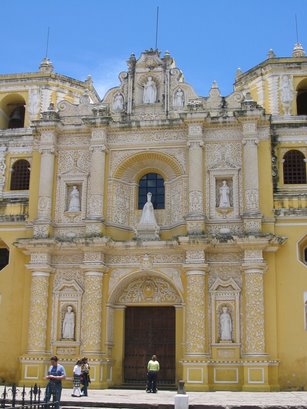
Church in Antigua

Church in Antigua

Tuesday, April 10, 2007

The Changing Role of the Private Sector

My Insights:
This week I was gave an presentation/oral review of an article I read on the topic of the changing role of the private sector in the global health arena. The article was called, "Yogi Wears Prada," from the WSJ in September 2006 and it discusses how the growth of high end yoga vacations is forcing traditional retreats to change some of their granola ways. The reason I talked about this article is because yoga (deeply intertwined with Hindu religion) as a private sector has now gone global (a $3 billion dollar industry in the U.S.). It is becoming prevenlent in the public health arena becuase it is used to help improve health by treating stress or even as a form of exercise. I thought it was important to discuss one case example of a private sector which has gone public and even become a watered-down version of what it was originally intended to to - as it does in this article. I wanted to explore the ramifications when one particular industry goes public and in all I thought it was great to consider ...
  • Is Yoga in the Western world a positive acculturation (do you view Yoga as a celebration of multiculturalism, promoting more open and tolerant cultural dispositions)?
  • Or, has this the processes of commercialization debased the sacred practice?

Graphical Reference: Privatization is thought to be evil, and public health is thought to be humanitarian - but when they work together are they like Jekyll and Hyde?

Unique Quote: "Blessed are the flexible, for they shall not be bent out of shape." - Unknown Author

Health Care Finance

My Insight:
Health care financing is a touchy issue - for two reasons - 1. it's expensive and 2. not everyone has access to health care services.
  1. Should health costs be the responsibility of public or private programs? And are we spending too much on health care? In 2001, internationally, we spent about $3,059 about 10% of the GDP.
  2. Even more prevalent - only 12% of this money is being spent on low and/or middle income recipients. Low and middle income people account for 84% of the international population and 92% of the burden of disease.

From these statistics one may observe that a lot of money is being spent, and somehow is being misdirected away from 84% of the global population who could benefit from it.

Graphical Reference:In the U.S., we spend 15.2% of our GDP on health care, which is more than any other country internationally.

Unique quote:"Fixing our health care system as a whole is our primary challenge, and to make it happen you need to get engaged – to pound the pavement, get your hands dirty, endure real sacrifice, take on antiquated thinking and help lead the public debate.” Senator John Kerry.

Responses to Natural Disaster


My Insights:
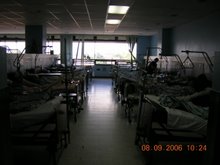
More resources need to be devoted to emergency preparedness. There is a ton of data which supports the idea that emergency health interventions like temporary shelters and field hospitals are indisputably more costly and less effective than preparedness-related health activities.

Several problems include: decision makers and relief workers lack of experience with disaster management because of frequent turnover in their jobs and lack of funding. Strategies include developing public support and political initiative in periods where there is no disaster. Efforts should commence in a long term, institutionalized format.

Graphical reference:
The hurricane Katrina in 2005, may not have only been the result of nature but potentially man made. Humans may be causing global warming and are thus the culprits of our own demise...

Inspiring Quote:
The human spirit needs places to go to, where nature has not been rearranged by the hand of man. ~Author Unknown

Technology Innovation and Global Health


My Insights are:
Times are changing. With innovations in information technology (IT), transforming health care through IT will result in significant cost savings to governments, insurers, and individuals over the long term as well as reduce stress on economies and workforces. It will provide opportunities for people to keep records of their own health.

Many inequalities exist in access to health care services with up-to-date IT developments (lack of available services to the public in developing nations and access limitations due to price inequalities in developed nations) and this is one of the biggest problems... how to effectively introduce IT innovations in a cost-efficient manner so that there is improved access to all. Another problem is that there needs to be global collaboration with the increase of more public-private parterships.

Graphical References:
Thermography as a way to diagnose breast cancer. It uses colorful imaging sensors to display areas where cancer could or is developing. Also the picture at right is a before (L) and after (R) of a hair restoration treatment at the Hair Restore Japan Contest in Tokyo.

Inspiration Quote:
Technology... is a queer thing. It brings you great gifts with one hand, and it stabs you in the back with the other. ~C.P. Snow, New York Times, 15 March 1971

Thursday, March 8, 2007

Technology Innovations


My Insights: Here are four challenges and great themes in the 21st century.


  • Integration of out international perspectives

  • Translating research into technological innovation

  • Create partnerships and alliances across industries

  • Demonstrate value and wealth through entrepreneurial ideas.

My initial thoughts to these four challenges is that they are redundant and simplistic but unfortunately these themes are still not a reality. It's easier said than done to envision a world who already follows all four of these ideals. We, as the United States are not yet integrating our technological advances, knowledge, resources and wealth with those in the developing nations (as we are a capitalistic nation) but we must integrate with each other. We must continue to translate new emerging ideas into technological advances. Yesterday, I read about the realization of providing HIV tests to those in the ER, in Los Angeles County, and providing test results to patients in a one hour turn-around time. The problem stated was that many people do not know they are carrying the HIV virus and for up to 10 years on average, it goes undiagnosed (according to NPR). Those who do take the HIV tests, have a tendency to not return after the two-week wait period and show up for the in-person deliverance of results. In other words, the waiting period is lengthy and the results are only given when patients show up in person, which is rather daunting to most (according to wsj.com). Anyways, translating the idea of awareness of HIV into technology is such as amazing idea for two reasons:


  1. Public health officials hope of improving health care delivered to those with HIV because an earlier diagnoses can help in delivering accurate treatment of HIV patients who are accessing basic and other services, and

  2. Reducing the number of incidence cases appearing because the assumption is that when people know they are HIV positive, they will take precautions to reduce the spread through sexually protected scenarios.

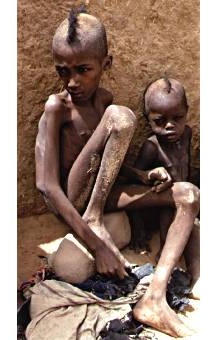
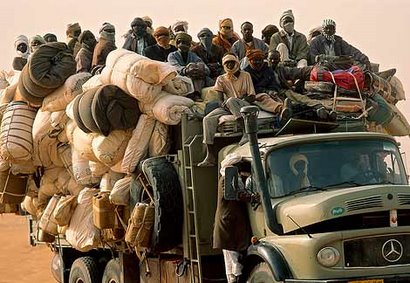
Graphical References: With rapid increases in biomedical sciences, millions of people living in developing countries are in situations of dire poverty with limited access to clean water sources, food, safety, homes and even basic health care. Why cannot the developed countries devote more resources with the potential for science and technology to merge to improve living conditions, control disease and improve lives.

Inspirational Quotes: "Discovery is seeing what everyone else has seen and thinking what no one else has thought." - Albert Szent-Gyorgi

Wednesday, March 7, 2007

Environment, Sustainability and Health

My Insights: From the reading, I learned about the unique relationship between... environmental pitfalls and poverty. I never really considered povery a link to environmental problems, but after the reading I do see a connection.

"Many environmental problems stem from poverty—often contributing to a downward spiral in which poverty exacerbates environmental degradation and environmental degradation exacerbates poverty. In poor rural areas, for example, there are close links among high infant mortality, high fertility, high population growth and extensive deforestation, as peasants fell tropical forests for firewood and new farmland..." - United Nations Development Programme (2003). Chapter 6 - Public Policies to Ensure Environmental Sustainability. Human Development Report 2003. Oxford University Press.

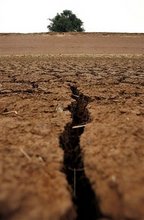
Graphical Image: Global warming is causing deserts to become drier which causes drought and famine (called desertification - like the Sahara in Africa); and ocean temperatures to raise and become warmer which will cause violent weather patterns like flooding, hurricanes and tornadoes (as in the Atlantic Ocean) .

Two Contrasting Unique Quotes on global warming that unfortunately have divided the people of United States:
"Two thousand scientists, in a hundred countries, engaged in the most elaborate, well organized scientific collaboration in the history of humankind, have produced long-since a consensus that we will face a string of terrible catastrophes unless we act to prepare ourselves and deal with the underlying causes of global warming."
AL GORE, speech at National Sierra Club Convention, Sept. 9, 2005

“...we have an environmental movement that is run by people who want to fight, not to win.”
Dr Patrick Moore, founder member of Greenpeace,writing in the Mail on Sunday, May 2000

Mind, Behavior and Global Health

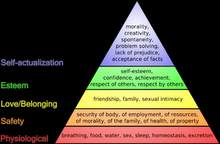
My Insights: In lecture 6, 2.16.07, we talked about mind and spirituality. I think the most memorable part of the lecture was when we talked about Maslow's Hierarchy of Needs pyramid. This is such a simplistic was to look at emotional and mental needs but I do agree that it is a great overview. It is cheifly suggesting that each individual has a set of needs, and with each step up the pyramid the individual is able to attain more superficial needs. For example the bottom-up approach is...
  1. Physiological - eat, breathe, water and sex
  2. Safety - security and health
  3. Loving/Belonging - family, relationships, intimacy
  4. Esteem - self esteem
  5. Self-Actualization - morality, creativity, spontaneity
Great Quote: it made me think of how powerful the mind is in relation to one's own reality.
"Let the beauty of what you love be what you do." - Middle Eastern quote